Armillary Sphere: Selection, Uses and Display Guide
Understand what an armillary sphere represents, how to compare its rings and base, and how to plan a stable, readable display.
Compare a ring-based celestial model with an orrery, and learn what each can communicate in a display or teaching setting.
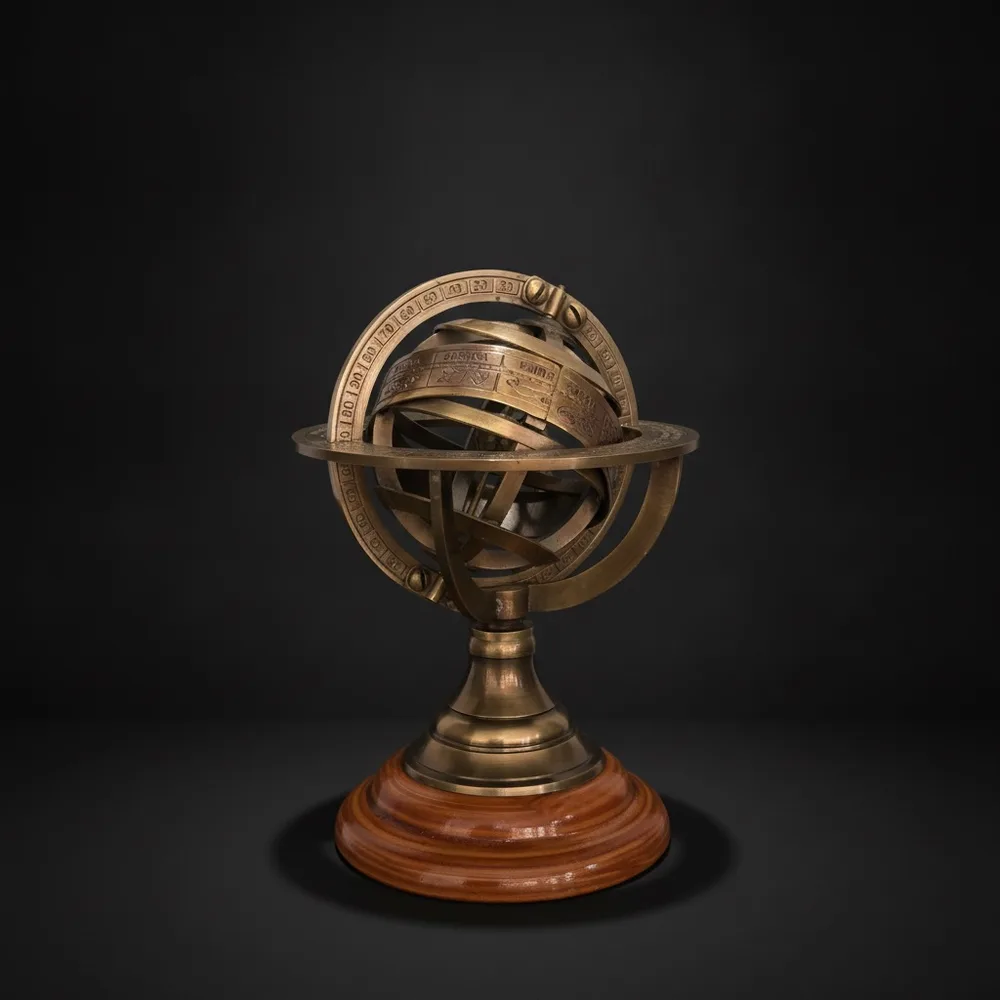
An armillary sphere and an orrery both make astronomy tangible, but they answer different visual questions. An armillary sphere uses intersecting rings to frame the celestial sphere and its coordinate circles. An orrery arranges planetary bodies around a central Sun to show orbital relationships. One is primarily a framework of reference; the other is a model of bodies and motion.
The distinction is useful when choosing a gift, planning a classroom demonstration or describing a display. A polished brass finish or antique-style base does not tell a buyer which kind of model they are seeing. Look at the central form and moving structure, then check the product description for what the particular model represents.
An armillary sphere surrounds an axis with rings. On a more explanatory model, these may correspond to circles such as the celestial equator, meridian or horizon. The rings give a three-dimensional way to discuss how astronomers describe positions on an imagined celestial sphere. Historical forms differ, and a decorative modern version may not carry a complete or correctly marked coordinate system.
An armillary globe adds a map of Earth among the rings. Antiqula’s catalog has examples such as a brass armillary sphere on a rosewood base (celestx-5-0) and an armillary globe on an MDF base (celestx-5-3). These records point to distinct forms, but do not on their own establish which circles are marked or whether they are adjustable. Confirm those details before presenting either object as a teaching instrument.
An orrery represents planetary bodies and their orbits around the Sun, typically with arms and sometimes a mechanical drive. It helps a viewer compare relative arrangement and imagine cyclical movement. It remains a model: unless the scale and gearing are documented, do not imply that distances, sizes or orbital speeds are represented proportionally.
The Antiqula desk model orbitx-8-0 is named as a brass solar system orrery. Its product page should be the authority for its materials, dimensions and operation. If a hand crank or moving arms are shown, explain only what has been confirmed for that reference. A model may be designed to move without reproducing the full complexity of planetary motion.
| If the display should… | Start with… | Ask before making a claim |
|---|---|---|
| Explain circles and celestial coordinates | Armillary sphere | Which rings are represented and which markings are present? |
| Show planets arranged around the Sun | Orrery | Which bodies are included, and what does movement demonstrate? |
| Include a terrestrial map within a celestial framework | Armillary globe | How are the globe and rings meant to be read together? |
| Invite close observation of a mechanical model | Orrery with verified moving components | Which parts move, and what handling guidance is supplied? |
Royal Museums Greenwich catalogs an armillary sphere as one object type and also preserves orreries that combine related functions: one collection entry describes a geared tellurium with a manual planetarium, while another is a portable orrery with tellurium and planetarium attachments. These examples show how historical models could combine functions. They do not make “armillary sphere,” “tellurium” and “orrery” synonyms. Describe the particular design and cite the object record that supports the comparison.
For a contemporary reproduction, the museum source provides context, not provenance. Similarity in brass finish, ring shape or base does not mean a retail piece is a copy of a named museum object. Keep any historical attribution tied to a verifiable maker, date and object record.
An armillary sphere often makes a strong starting point for a conversation about how people map the sky. Its rings can be traced and compared, especially if the model has clear markings. An orrery is more immediately suited to questions about planets and orbital cycles. A visitor can see a central point, orbiting arms and bodies without first learning the geometry of the celestial sphere.
In a gift shop or home office, the decision may be primarily visual. The open rings of an armillary can read as a sculptural outline, while the clustered arms and spheres of an orrery create more movement within a compact footprint. Compare assembled height and the reach of the widest moving part, not just the diameter of the central globe. Allow clearance around a moving model if it will be operated.
For a classroom, pair either model with a simple diagram and a statement of what it leaves out. Both simplify reality. The Earth is not at the centre of the solar system, and an armillary framework is not a literal shell around the planets. Explain the model’s viewpoint so a striking object does not accidentally reinforce the wrong picture.
Use the category name that matches the object page. If the catalogue identifies a model as an armillary globe, do not relabel it an orrery because it has rotating rings. If it is a tellurium showing the Earth–Moon–Sun relationship, identify those components only when the product record confirms them. “Astronomical model” is a useful broader term when the exact mechanism is uncertain.
Before a wholesale order, compare the reference, dimensions, base, included parts and confirmed movement. Ask for a demonstration or additional photographs if function is central to the purchase. That simple check preserves the distinction between an evocative desk object and a model intended to teach a particular relationship.
Catalogue reference: CelestX 5.0. Listed material: Solid Brass.
Check the current product page and ask for model-specific dimensions, packaging and suitability before ordering.
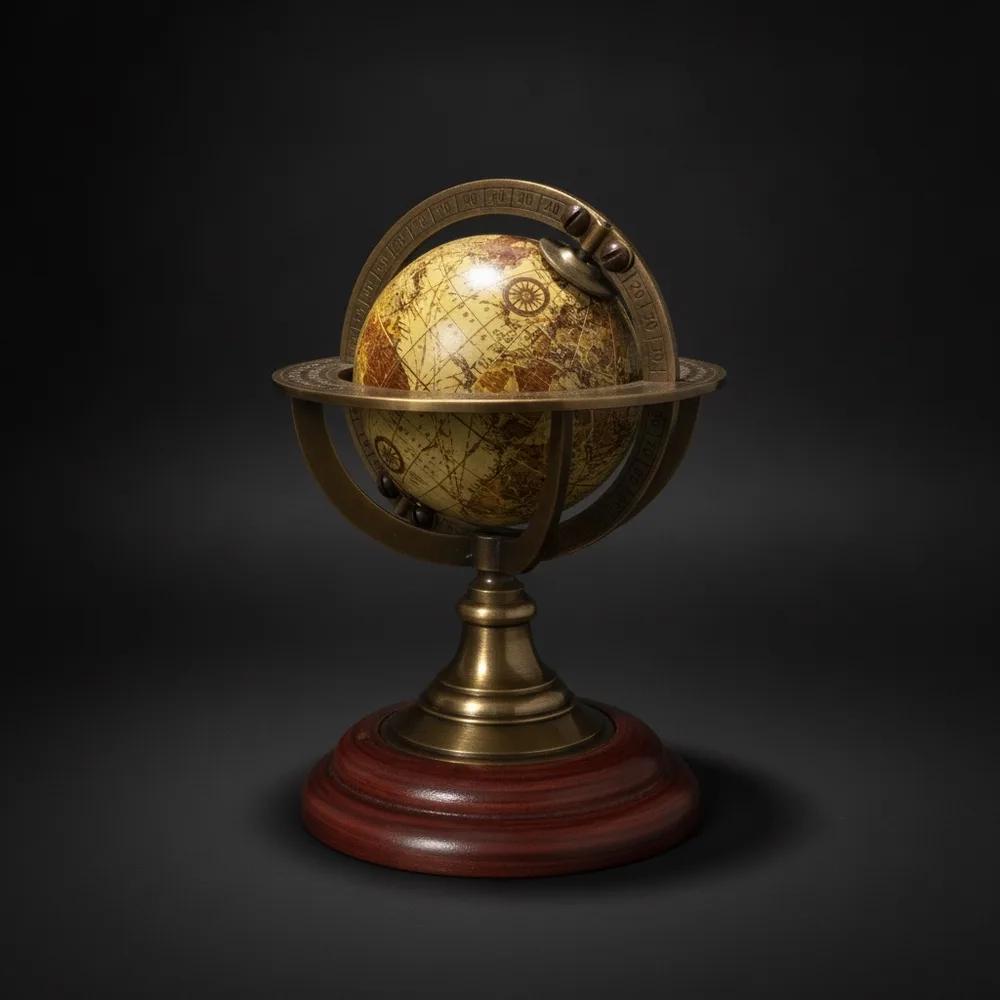
Catalogue reference: CelestX 5.3. Listed material: Solid Brass.
Check the current product page and ask for model-specific dimensions, packaging and suitability before ordering.
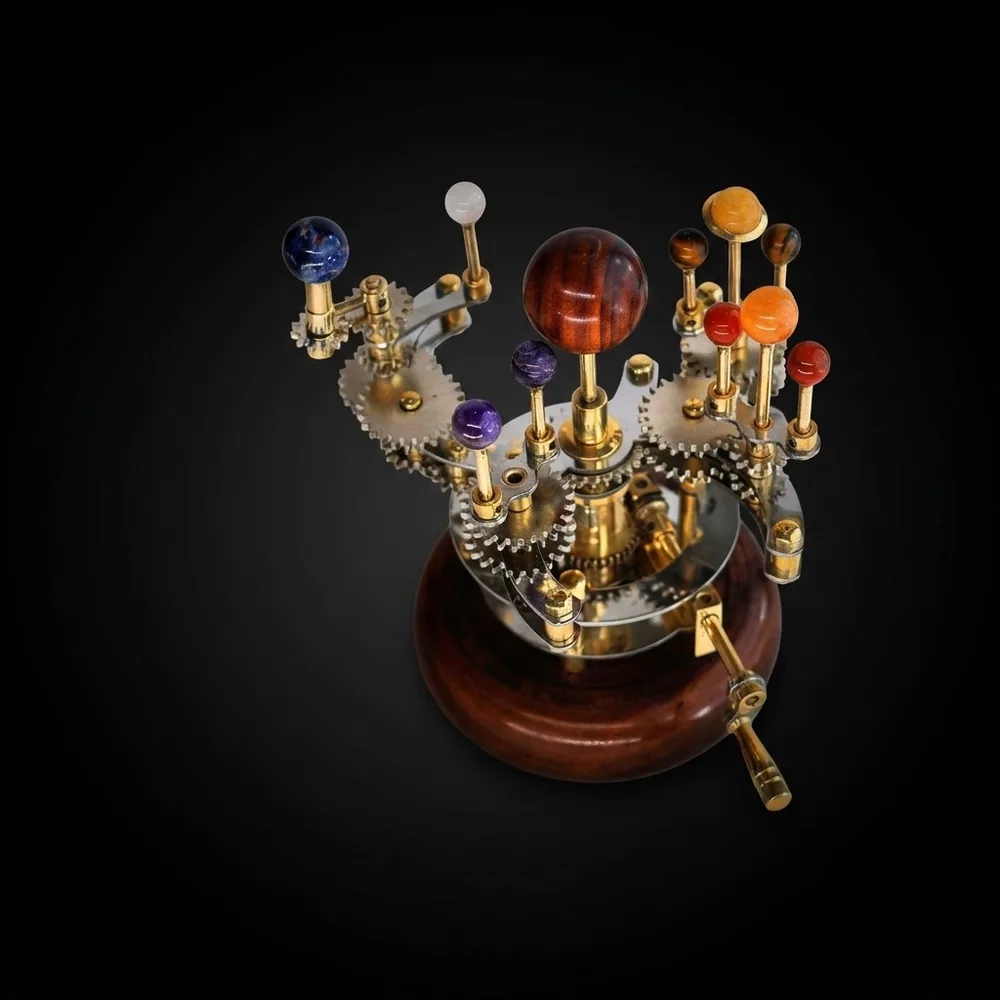
Catalogue reference: OrbitX 8.0. Listed material: Brass, Stainless Steel, Rosewood.
Check the current product page and ask for model-specific dimensions, packaging and suitability before ordering.
Explore Antiqula’s armillary sphere catalogue
Catalogue examples were checked against Antiqula’s product records on 2026-10-02. Research sources provide context; they do not certify the performance of individual catalogue products.