Desk, Shelf and Museum Orreries: Choosing the Right Scale
Plan an orrery display around footprint, moving-part clearance, viewing distance, access and interpretation.
Choose an orrery by what it models, how it moves, its footprint and viewing distance, with clear limits for educational claims.
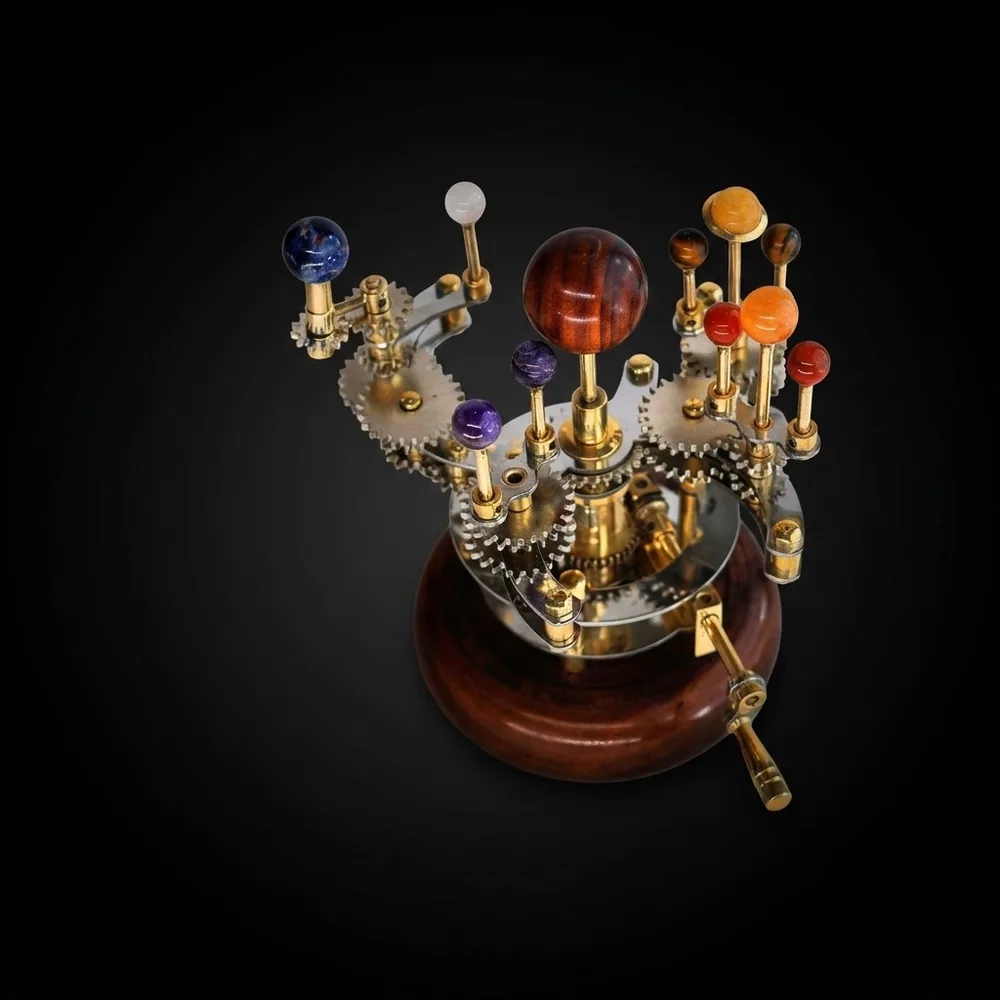
An orrery makes a model of celestial relationships that can be seen and, in some designs, set in motion. A central Sun, orbiting arms and small planetary bodies give the viewer a way to talk about arrangement and cycles. The model is also a finely layered object: the base, crank, gears, rings and planet materials can determine how it is handled and where it belongs.
Antiqula’s category spans desk and shelf presentations, including a Brass Solar System Orrery (orbitx-8-0), a version with semi-precious stone planets (orbitx-8-1) and a Sun–Earth–Moon tellurion model (orbitx-8-5). Use those names to locate individual references, then confirm exact movement, contents, dimensions and instructions on the current product page. Do not assume every model includes the same planets or mechanism.
An orrery generally depicts orbital relationships, often placing planetary bodies around a central Sun. A tellurium, or tellurion, focuses on relationships involving the Earth and other celestial bodies, commonly the Sun and Moon. Historical models could combine mechanisms: Royal Museums Greenwich catalogs one orrery with a geared tellurium and manual planetarium, and another portable orrery with tellurium and planetarium attachments. That variety does not make these terms interchangeable for every modern desk model.
Read the listing for the exact components shown. If the model includes a crank, ask what turns and whether the mechanism is intended to be operated. Confirm whether planets are fixed to arms, whether the central body is included and what instructions accompany it. If a product’s operation is not described, treat it as a display model until the supplier clarifies.
A moving mechanical model can make an orbital relationship easier to discuss, but it necessarily simplifies. Physical spheres are not drawn to the same scale as orbital distances. A crank may link movement without matching the real periods of each planet. Some representations use rings or only a selection of bodies. Before using one for instruction, ask what is represented and what is omitted.
Avoid claims such as “accurate solar system scale” or “shows the planets’ exact speed” unless model documentation establishes precisely what is scaled and how. Even when gears move in a regular pattern, this does not automatically reproduce astronomical timing. Use a diagram or reliable reference alongside the object when a lesson depends on a quantitative relationship.
The planets’ appearance changes the object’s character. Brass-coloured spheres create a unified metalwork impression; semi-precious stones or glass marbles make individual bodies stand out by colour and material. The selected model title should guide the description, but confirm the exact material and variation before promising that every unit has the same appearance. Natural stone can differ between pieces.
The mechanism is another decision. A hand-operated model may encourage demonstration, while a fixed model is best treated as an arrangement to observe. Ask about crank resistance, exposed moving joints, assembly and care. Do not spin a mechanism quickly or force it through resistance. If visitors will handle the object, define which parts they may touch and place it on a surface that can bear the full footprint.
| Comparison | Desk model | Shelf or cabinet model | Museum or learning display |
|---|---|---|---|
| Primary need | Manageable footprint and close inspection | Stable placement with a clear silhouette | Visibility, interpretation and controlled access |
| Important measurements | Base, overall height and crank clearance | Shelf depth, clearance above and viewing angle | Plinth size, sightline, reach and accessibility |
| Handling | Owner can operate if documented | Usually occasional, with support nearby | May require staff demonstration or a barrier |
| Interpretation | Short model description | Label and product details | Context, sources and explanation of limitations |
A desk or shelf orrery is designed to be encountered close up. Fine rings, rods and small bodies may disappear from across a large room. Conversely, a broad model can overwhelm a small desk or sit too near a wall for an arm to move freely. Measure the base and the reach of all moving components, not only the central platform. Include clearance for a person’s hands if the mechanism will be used.
For a museum or classroom display, think about sightlines first. Can a person using a wheelchair see the central structure? Can a group gather without blocking a doorway? If the model is behind glass, will reflections obscure small labels? A protective case may improve safety but make interaction impossible. Consider a documented staff-led demonstration or a separate diagram if visitors need to understand motion.
Start with what a visitor can observe: which body sits at the centre, which arms move and which components represent planets or a moon. Then state the model’s viewpoint and simplifications. A clear caption might note that an orrery represents orbital relationships with a mechanical model, while its sizes and spacing are not a literal map of the solar system—if that is true for the object at hand.
If the model is associated with a historical instrument, cite the specific source and distinguish that example from the modern product. The Royal Museums Greenwich records offer primary collection context, including specific compound mechanisms in historic orreries. That is a better basis for historical nuance than claiming that a contemporary design is “the original” form of an orrery.
Before placing the model in a public setting, identify vulnerable points. Thin arms, loose-looking spheres, gear teeth and decorative uprights are not handles. Put any crank in a position that does not project into a walkway. If the product is operable, follow the instructions and demonstrate slowly. If directions are absent, seek guidance rather than experimenting with the mechanism.
Keep dust away from joints and use only finish-appropriate cleaning advice from the supplier. Avoid abrasive polishing on decorative metal surfaces and do not apply oil to gears unless recommended. For storage, use packaging that supports the base and keeps arms from bearing weight. A fitted carton can prevent movement in transit; do not pack loose fill against delicate components.
For each reference, note model type, bodies represented, moving parts, power or hand operation, materials, dimensions, base, case or packaging and instructions. Mark any scale or timing claim as confirmed or unconfirmed. For trade enquiries, state where the model will be displayed and whether visitors will handle it, then request sample, availability and current terms for the named product IDs.
An orrery can reward close attention without promising more than a model can show. Choose one whose scale suits the room, whose mechanism suits the intended interaction and whose explanation helps visitors see both the idea and its limits.
Catalogue reference: OrbitX 8.0. Listed material: Brass, Stainless Steel, Rosewood.
Check the current product page and ask for model-specific dimensions, packaging and suitability before ordering.
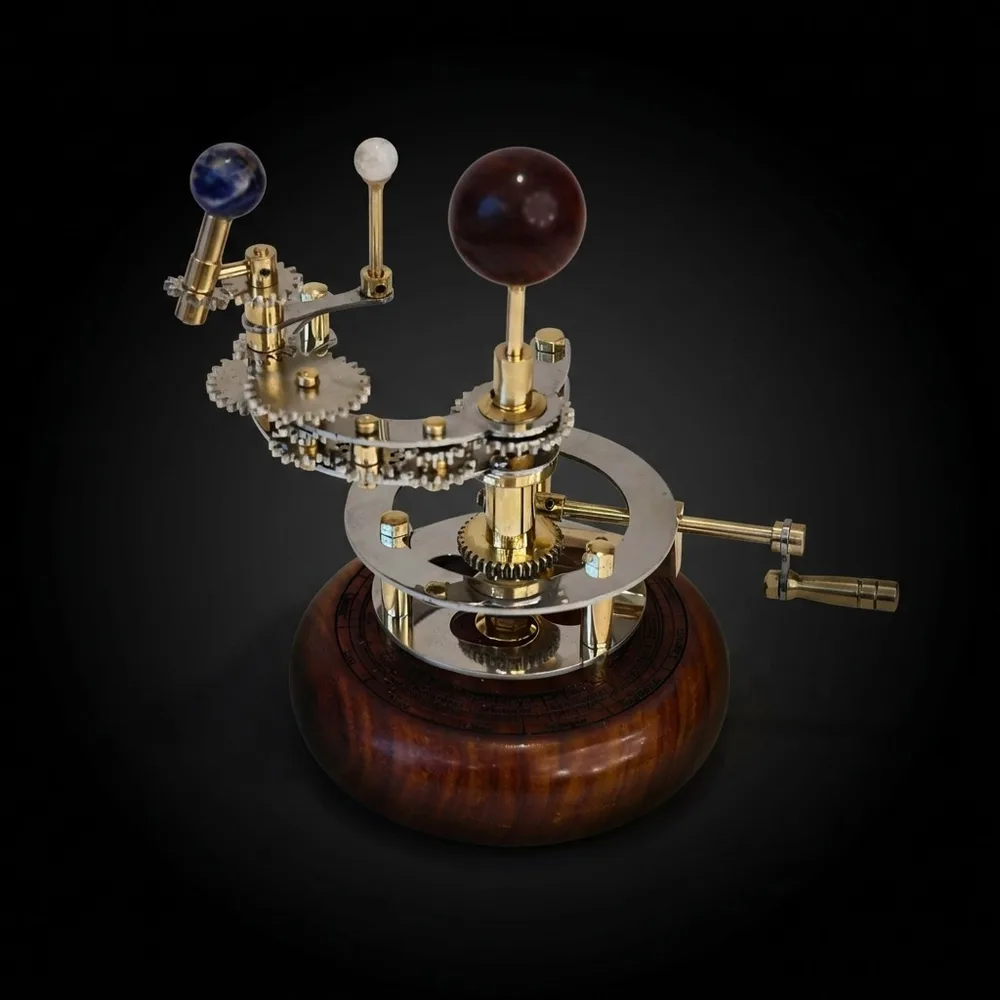
Catalogue reference: OrbitX 8.1. Listed material: Brass, Stainless Steel, Rosewood, Semi-Precious Stones.
Check the current product page and ask for model-specific dimensions, packaging and suitability before ordering.
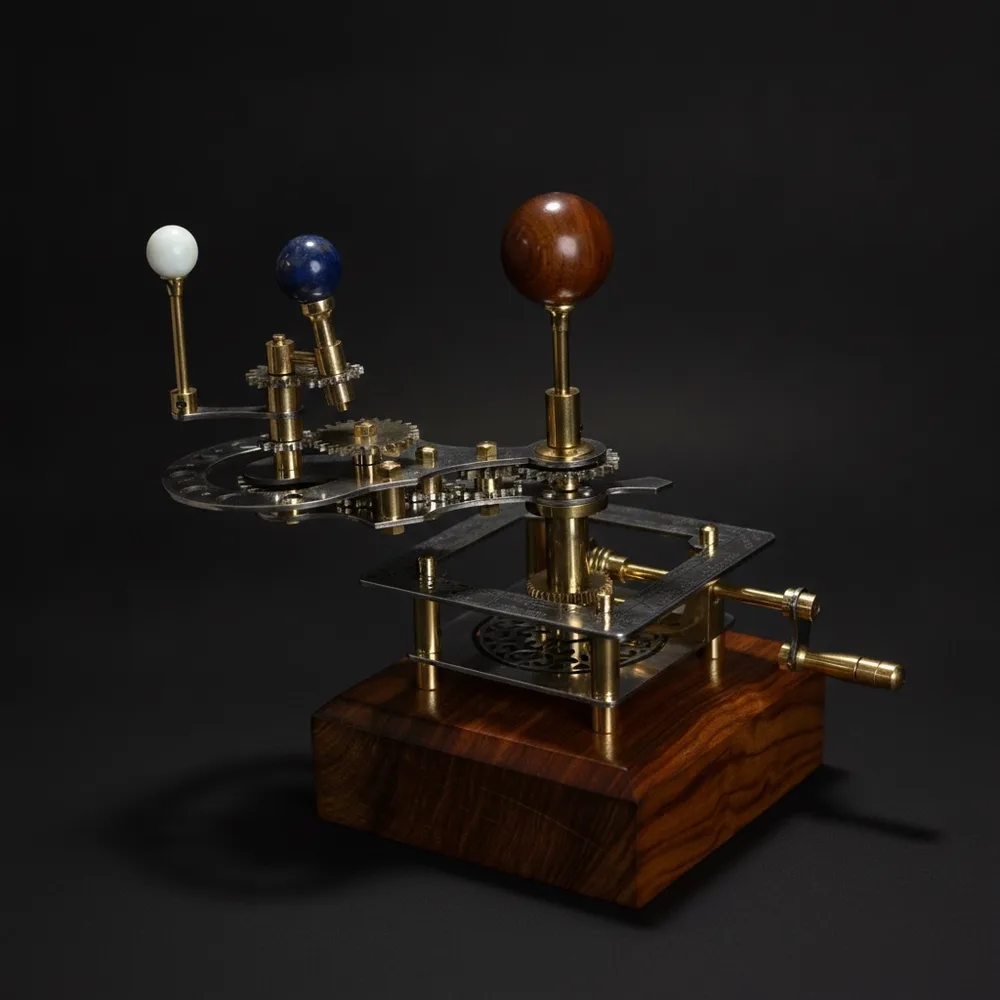
Catalogue reference: OrbitX 8.5. Listed material: Brass, Stainless Steel, Rosewood.
Check the current product page and ask for model-specific dimensions, packaging and suitability before ordering.
Explore Antiqula’s solar system orreries catalogue
Catalogue examples were checked against Antiqula’s product records on 2026-10-02. Research sources provide context; they do not certify the performance of individual catalogue products.