Orreries: Selection, Uses and Display Guide
Choose an orrery by what it models, how it moves, its footprint and viewing distance, with clear limits for educational claims.
Plan an orrery display around footprint, moving-part clearance, viewing distance, access and interpretation.
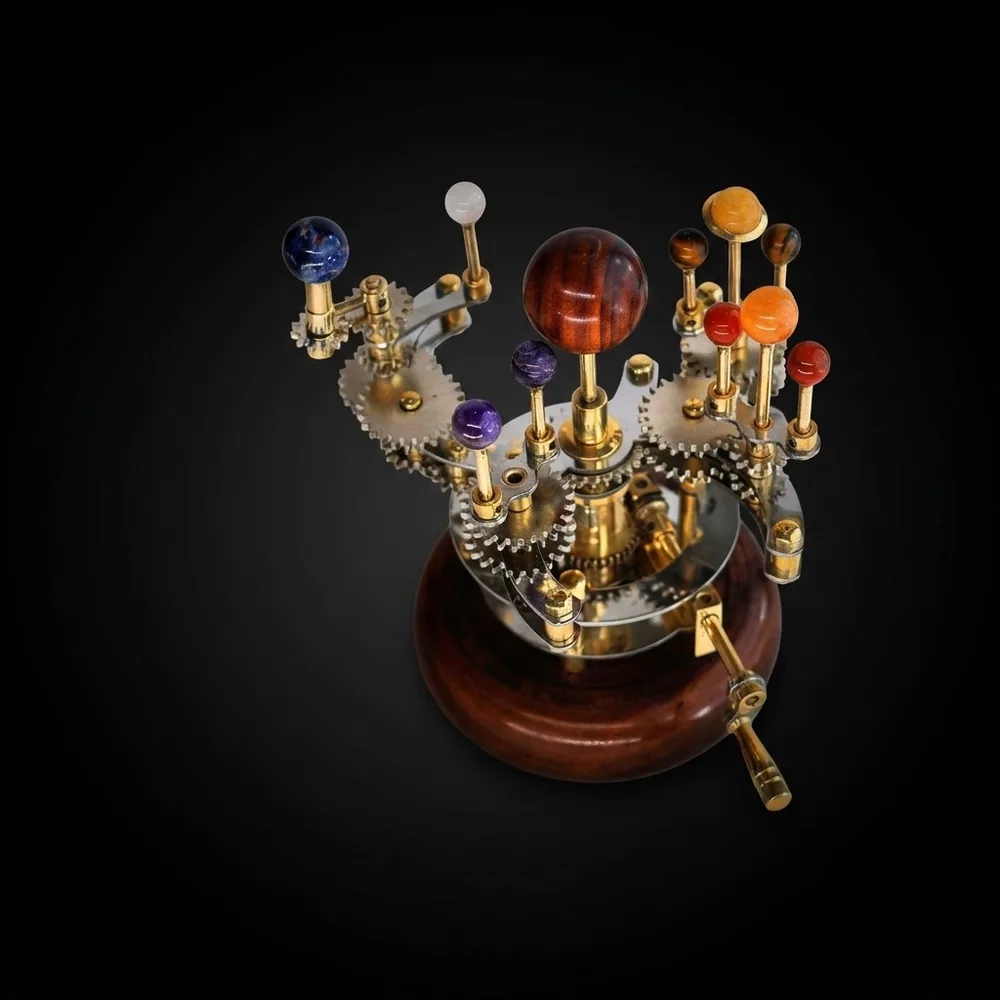
The right scale for an orrery depends on how close people can get and whether the mechanism will move. A desk model can reward one person looking at its arms and small bodies; a shelf piece needs a clean silhouette against nearby books; a museum or classroom display must remain visible to a group and safe to approach. Sphere diameter alone cannot answer those questions. Measure the base, highest point and reach of moving parts.
Antiqula’s catalogue includes desk and shelf models such as orbitx-8-0 and a Sun–Earth–Moon tellurion, orbitx-8-5. Check each reference’s current dimensions and instructions before assigning it to a setting. A name that says “desk” is a clue, not a substitute for measuring the actual surface and clearance.
On a desk, the model competes with papers, monitors and lamps. Choose a stable section of the surface and reserve enough room for the base plus a person’s hands. If the orrery has a crank, its path must not strike a wall, monitor or lamp. Check whether the crank is removable or folds only when the product details confirm it.
The eye-level relationship matters too. A low model can be hard to inspect from a seated position if it sits behind a screen; a tall model may obstruct work. Place it where the viewer can see the central body and orbiting structure without leaning over the mechanism. If regular operation is not essential, a side table or cabinet may give it a better setting.
A shelf display should make the object’s outline readable. Leave space above it for raised arms and enough depth so the base is fully supported. A shelf that is only wide enough for the base may still be too shallow if a projecting component extends forward. Consider whether the model can be reached for cleaning without catching an arm on the shelf above.
For a glass-fronted cabinet, look at reflections and the viewing angle. A clear door protects the object but may hide small components under bright overhead lights. Use a small label that identifies the model and its confirmed mechanism. Keep loose accessories in a separate compartment rather than placing them beside moving parts where they may be mistaken for components.
A larger institution display introduces access questions. Can a visitor see the model from standing and seated positions? Is there enough room for a group to gather without blocking circulation? If interaction is planned, is it self-guided or led by staff? A movable model can be compelling, yet repeated visitor operation can put strain on delicate linkages. A protected display paired with a diagram or demonstration model may work better than asking everyone to handle a single collectible.
Labels should explain what is being modelled and where the simplification lies. An orrery can depict orbital relationships, but its planet sizes, distances and motion may not share one scale. Do not infer those relationships from appearance. Cite a reliable astronomy or museum source for the historical idea, and identify the retail object separately as a contemporary model unless a provenance record says otherwise.
Royal Museums Greenwich catalogs a portable orrery with tellurium and planetarium attachments and a second orrery combining a geared tellurium with a manual planetarium. These records show that a historical instrument could combine mechanisms. Use them as specific examples rather than universal templates for every present-day product.
| Placement | Measure | Design around |
|---|---|---|
| Desk | Base, total height and crank reach | Papers, screens, lamp glare and seated sightline |
| Shelf | Depth, overhead clearance and access | Books, cabinet edge and safe cleaning access |
| Museum plinth | Full silhouette, label area and visitor sightline | Seated access, crowd flow, barrier or demonstration plan |
| Classroom table | Footprint and reach from each side | Group visibility, supervised handling and return to storage |
If movement is a selling point, confirm exactly which parts turn, how they are driven and whether an instruction sheet is provided. Do not assume that movement follows accurate planetary periods or that the entire system turns as a unit. Demonstrate only the operation shown by supplier instructions or a tested sample.
Likewise, “museum scale” is not a universal technical category. It can mean a display intended for an institutional setting, but it does not establish a particular size, historical authenticity or conservation standard. If a museum needs a piece, state the requirements directly: dimensions, materials, interpretive purpose, handling frequency, case needs and documentation.
Choose a contrasting background so small arms and planets remain visible. Avoid a busy celestial mural directly behind a brass framework; it can merge with the object’s silhouette. Place a concise label beside the model rather than on a surface where visitors must lean over moving pieces. For an interactive demonstration, mark a clear standing position and keep hands away from exposed gears or narrow joints.
Keep packaging and assembly instructions with the object’s records. If the model must move between locations, support the base and protect arms from lateral pressure. Dust with an appropriate soft tool and follow finish-specific care advice. Do not oil gears, tighten joints or polish the finish based on guesswork.
Before purchasing, record the product reference, assembled measurements, moving-part envelope, viewing distance, surface or plinth dimensions, light conditions, assembly requirements and handling plan. Photograph the proposed location with a ruler or marked footprint if the supplier needs context. For a public installation, add accessibility and visitor-flow checks before ordering.
Scale is successful when the model can be seen clearly, supported fully and interpreted responsibly. A compact orrery need not dominate a room to invite curiosity; a larger piece earns its footprint when its structure remains visible and the visitor has a thoughtful way to encounter it.
Catalogue reference: OrbitX 8.0. Listed material: Brass, Stainless Steel, Rosewood.
Check the current product page and ask for model-specific dimensions, packaging and suitability before ordering.
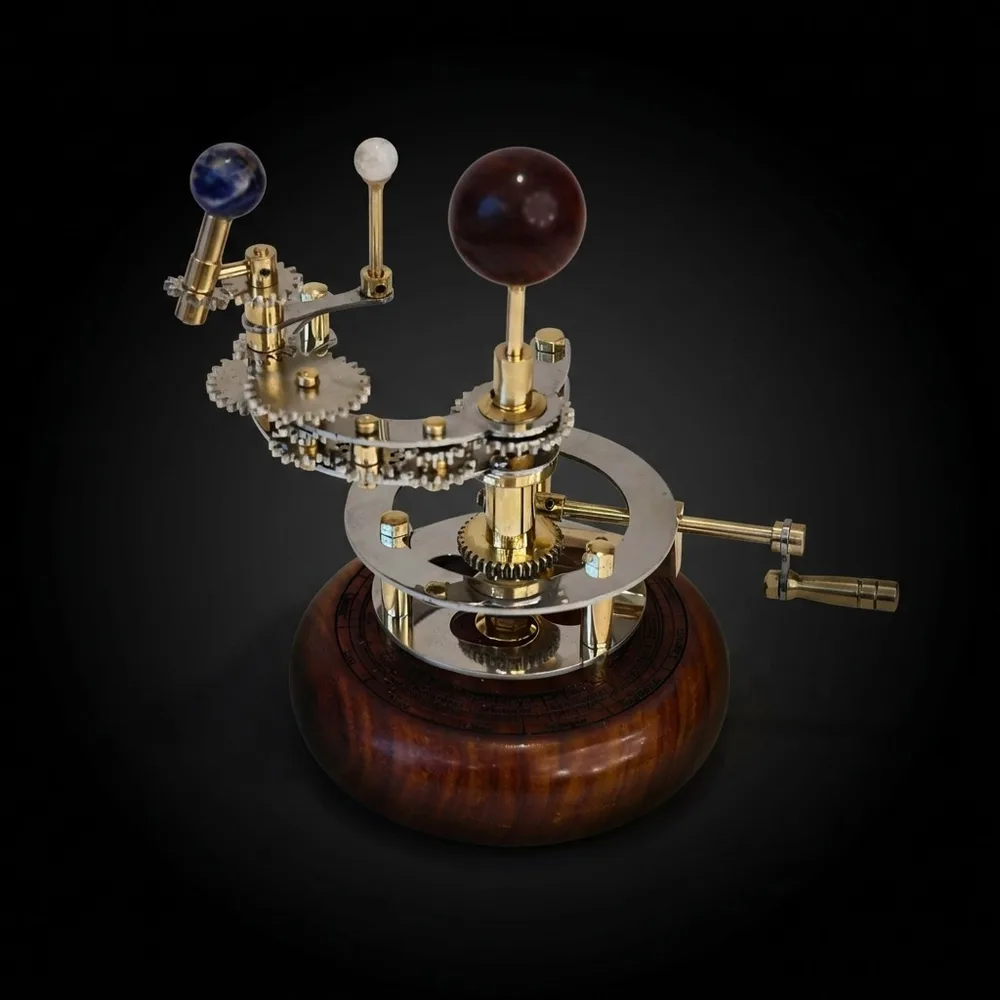
Catalogue reference: OrbitX 8.1. Listed material: Brass, Stainless Steel, Rosewood, Semi-Precious Stones.
Check the current product page and ask for model-specific dimensions, packaging and suitability before ordering.
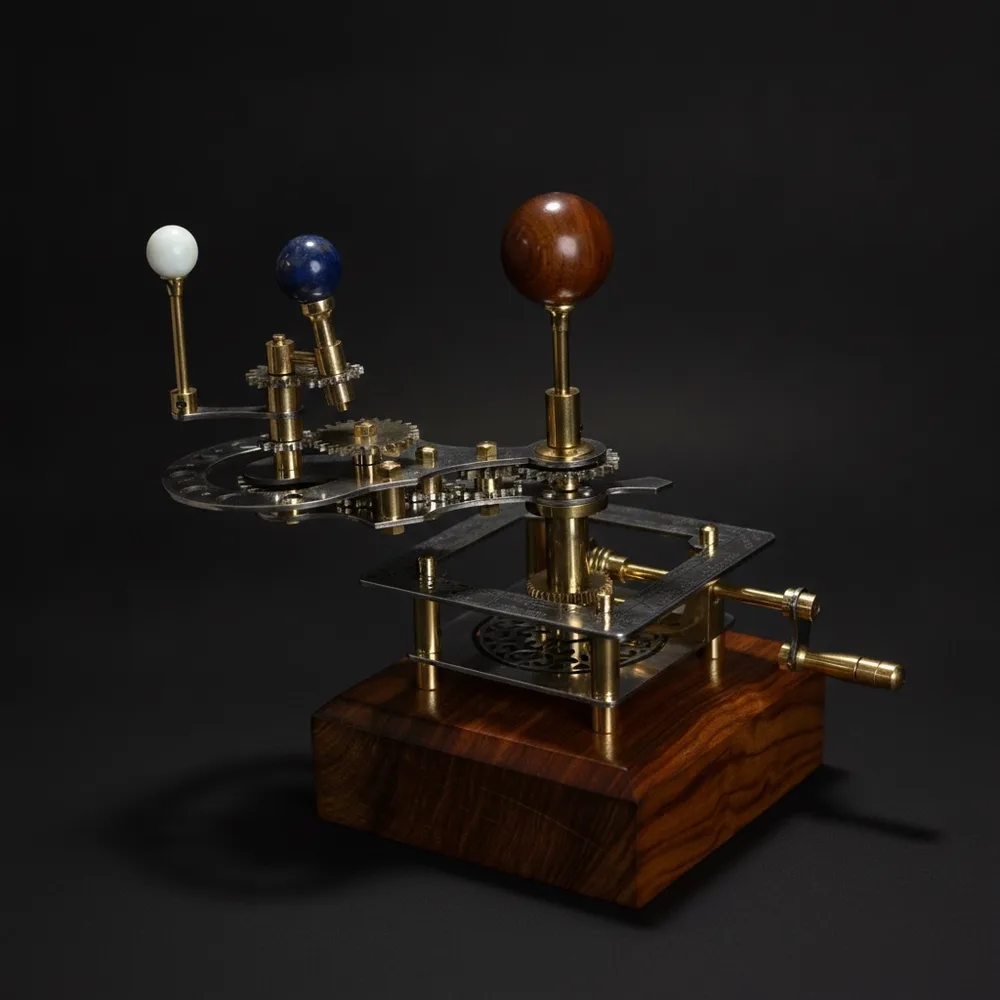
Catalogue reference: OrbitX 8.5. Listed material: Brass, Stainless Steel, Rosewood.
Check the current product page and ask for model-specific dimensions, packaging and suitability before ordering.
Explore Antiqula’s solar system orreries catalogue
Catalogue examples were checked against Antiqula’s product records on 2026-10-02. Research sources provide context; they do not certify the performance of individual catalogue products.